
Here’s a poet whose work means so much to our communities’ fight to decolonize Canadian culture. A poet for the people, Chet Singh’s poetics are incisive and illuminating. His brilliant analysis and political assertions are stylized into language and riddim-flow that create a powerful voice for resistance and transformation.
- Lillian Allen, Dub Poet and Juno Award winner
Chet Singh’s “poeletic,” in other words his poetic and political sensibility, is one deeply in tune with the profound rhythms of a global and environmental dynamic, of collaborations, of forming alliance with like-minded people who are doing the work of social justice in other ways, an observation that is startlingly apparent in his engagements with other cultural workers…… Don’t be surprised if his words incite you in a wake up call to respond, one that says to those of you listening in from elsewhere to “get up, get up” and do something. Because his words openly rebel against many forms of oppression and put forward, maybe even demand, settled commitments from each of us.
-Phanuel Antwi, Canada Research Chair in Black Arts and Epistemologies
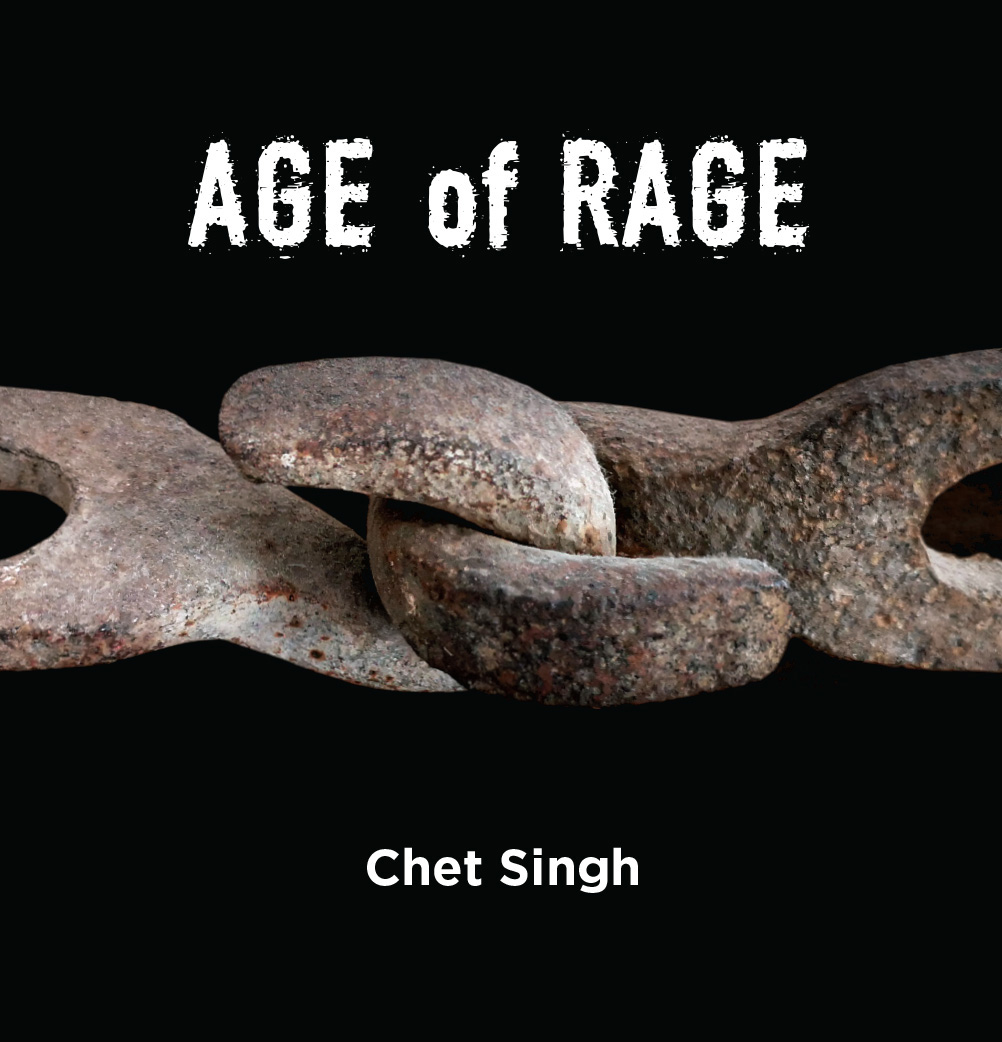
ABOUT THE NEW ALBUM: Age of Rage
Chet Singh’s 6th album, Age of Rage produced with DJ Gerhard Gepard, currently an Eastern European-based itinerant sound designer, was 3 years in the making. Gepard weaves dub inspired electro-acoustic aesthetics against the backdrop of Chet’s meditative and rebellious contemplation of a world fuelled by tyranny, extremism, greed and rebellion demanding our attention, if not action.
Guns & Gods anticipates the re-emergence of fascist and authoritarian values embedded in the body politic where distraction and blame is the name of the game. Kaputalism and Red Maple reminds us of the disconnect between democratic ideals, colonialism and capitalism. Re-run suggests that imperialism is the root cause of the so called ‘migrant crisis,’ where displaced peoples are demonized and exploited. Canadian Studies and System is a Bust reflects on Chet’s work as an internal chance agent while working in environments hostile to equity, diversity and fairness. Unity Musicillustrates how the far right appropriates the language and symbols of progressive movements while celebrating greed and division as ‘holy’ virtues. Father Poem comments on the tendency of many anti-colonial movements to adopt harmful ideologies in various struggles for liberation. Coyote examines our relationship to nature as we continue on a path that leads to devastation and extinction. One hopeful track is a dub version of One Mind’s, Love Needs Expression.
Press for Age of Rage

Press for Diasporic Dub
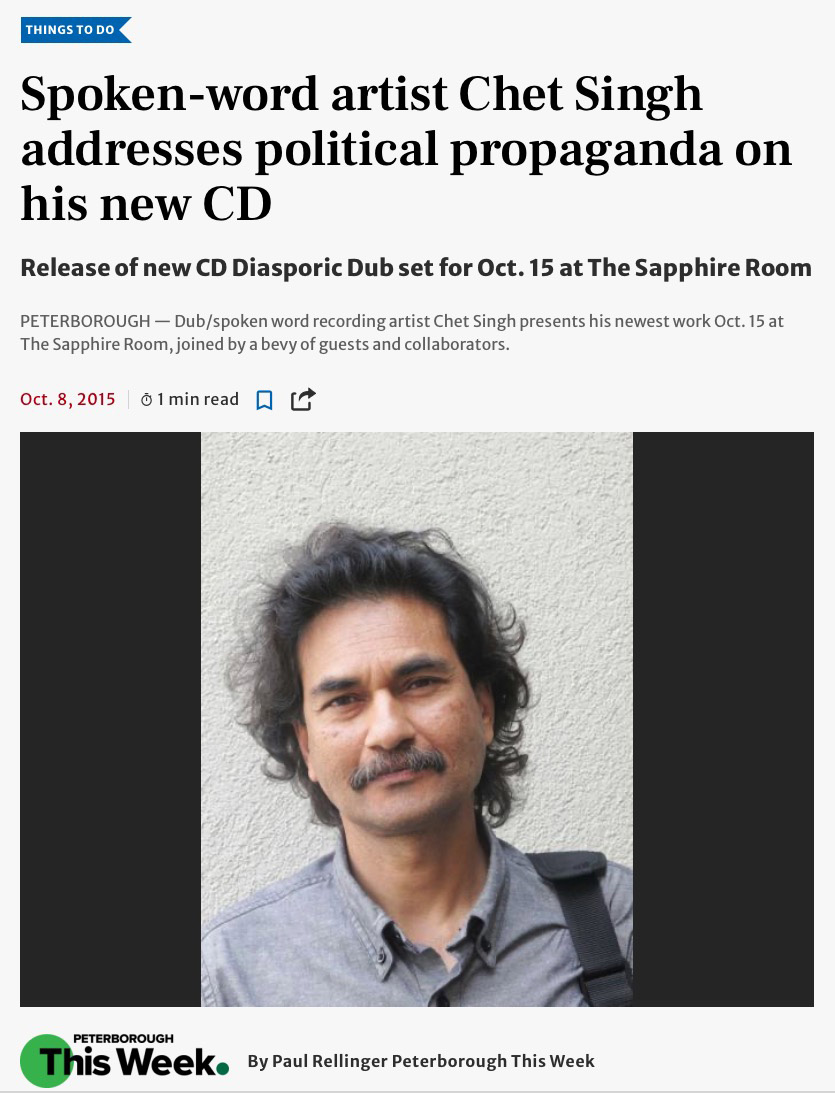
Press for Occupation Nation
Press for Recessionary Revolutionaries
Press for Darkness of Daylight
Structures of Complicity: CD review of Darkness of Daylight, by Chet Singh with Dub Trinity (2007)
Written by trent arthur
Monday, 10 March 2008
Sometimes it can feel like that, mimetic and empty of substance, even Adornian, to an undergraduate student looking ahead at a lifetime of corporate drudgery that seems to be mapped out in advance. You imagine slotting yourself into a ready-made opening in a corporate niche on the basis of a certain slim skill set, and then settling down into a dark cubicle for an indefinite span, far from sunlight, feeling paradoxically lucky and condemned.
Sometimes it can feel like that, mimetic and empty of substance, even Adornian, to an undergraduate student looking ahead at a lifetime of corporate drudgery that seems to be mapped out in advance. You imagine slotting yourself into a ready-made opening in a corporate niche on the basis of a certain slim skill set, and then settling down into a dark cubicle for an indefinite span, far from sunlight, feeling paradoxically lucky and condemned.
On Darkness of Daylight, his latest collaboration with local roots-rock-reggae band Dub Trinity, Canadian Dub poet and social justice activist Chet Singh expresses this feeling well: “Step out into the unnatural light, uranium night,” he says ominously in “Electric Man,” the song of the album’s title phrase. He queries surveillance in the workplace and other 21st century workplace hazards such as harassment, discrimination, overtime, and stress.
Singh’s choice of words in “Electric Man,” underscored with a dark, catchy bass synth line, is particularly significant in the wake of the recent arrests of Trent professor Paula Sherman and Fleming College professor Bob Lovelace during actions against the uranium prospecting and mining on Ardoch Algonquin First Nations ancestral lands by private company Frontenac Ventures. At a time when Trent and the greater Peterborough community is faced with parallel questions, Singh knits together his concerns for workers’ rights with questions about their complicity: “Are we becoming gate-keepers of institutions, or are we agents of transformation?” he asks.
Singh, who on 2002’s Dub Trinity and Chet Singh rescripted the national anthem to read “Oh Canada, our home on native land,” credits the milieu of his youth for establishing his social consciousness. Born in Jamaica and raised in the Caribbean, Singh began using “the revolutionary art form of dub poetry” in the early 1980s with the formation of his reggae/punk/Latin fusion band One Mind. Singh felt that dub, an “oral tradition born out of the material conditions of oppression and discrimination” and especially concerned “with excavating normalized discriminatory discourses and practices that perpetuate social and economic inequities,” was well-suited to his politics as an activist. He continues this musico-political activism on Darkness, his second release with Dub Trinity. In “Red Maple,” a track about nation-building, he succinctly sums up the interrelation of colonialism, capitalism, politics, anti-environmentalism, and racism: “Red maple rooted in aboriginal soil.... Our ruling classes have priced it all, the water, the air, the DNA in my balls.”
Darkness is unrelentingly political and tackles collusion with the system on multiple tracks, including “December 6th,” about the 1989 massacre of 14 women at l’École Polytechnique on that date in Montreal. “Do you remember that day in December,” he begins, exploring the underlying systemic structures that may have led to Marc Lépine’s vitriol towards women and feminists. Singh comments darkly on the interpellation of men into these structures of discrimination and violence: “At the age of 3, they gave me a gun; boys will be boys, let them have fun.... By 13, misogyny was running through me.”
With a cymbal-heavy, two-step drum n’ bass beat in “Identities,” Singh rescripts the symbology of dancehall critiques of the oppressive “Babylon” culture, using the term to refer instead to the “inner culture” of homophobia of some dancehall djs who direct their “killer lyrics” towards queer people. “Privilege and marginalization are contextual,” Singh notes, depending on “messy” categories; by ignoring the “nuances and interconnections” of identities, he states, “we may well be replicating that which we were attempting to eradicate.”
Occasionally, Darkness slips into exactly the sort of political univocity that Singh warns against. In the opening track “Price is Right,” the alignment of time signatures seems to have been sacrificed to the fervour of the message. Singh’s lyrics are cramped together in their urgency, lacking the negative space needed to offset his satiric points about the co-optation of revolutionary symbols by corporate interests (“There’s a man with a blackberry makin’ a call; the human stockpile is about to fall”). The instrumentation on this track seems to parachute down into Singh’s musical ontology from elsewhere, spread poorly over his vocals under the cover of dub “jazziness.”
Yet while some tracks may be hampered by the weight of their political message, others, as in the laid-back jazz lull of “Jane & Finch,” the lively vocals and trumpet accompaniments of “Buskin,” and the poppy “Abstract Graffiti,” blend the positive and negative spaces of Singh’s dub vocals together with compelling rhythms and expressive, layered percussion. On these tracks Singh is most successful, luring the listener into complicity with the rhythms of his well-wrought vocals, even as he asks us to raise our awareness and become conscious of how easy it is to be swayed by the medium, at the expense of the message. Noticing the medium, Singh seems to suggest, means noticing the cubicle walls and what fills them. This may be the titular daylight in darkness; the substance underlying the empty mimetic form of corporate nichedom is ourselves, and what renders the form neutral or invisible is our complicity: we choose to fill each slot as if it were a given.
Press for Chet Singh & Dub Trinity
EXCLAIM!
April 2005
• • •
Dub Trinity CD Captures Sounds of Genre
Peterborough Examiner
November 27, 2004
Local musicians Beau Dixon and Greg Roy have been sending out good musical vibes as the fun live act Dub Trinity for a few years now. This new collection captures well the sounds this band creates in such a setting.
A political bent takes a firm front seat, with the music always holding its own. Dixon, Roy and Singh mesh Dub, reggae and other sounds of protest into a northern influenced compote of cool sounds and outta sight beats. Dub Trinity works as a collective, involving guest musicians and an array of locals in creating their strident sound and message.
The set opens with Another Statistic which sends a strong crime message, while other tracks touch on personal, environmental and political issues.
You may have caught this band on the main stage at the Folk Festival in 2003. Since then, regular club dates have happened, giving this area a real taste of dub, and its firm message.
– Jeff Macklin
• • •
Chet Singh & Dub Trinity
Ottawa Express
April 2005
"Canadians get up, get up!"—Chet Singh delivers a poetic wake-up call for complicit Canadians to stand up and fight against the erosion of social programs on "Counter Attack'.'one of many verbally explosive songs on Biographies. The new album is a collaborative effort with Toronto duo Dub Trinity. Singh, a Jamaican-born Peterborough-based poet-activist, mixes rebellion with the Trinity's dub-flavoured island music that occasionally includes Santana-esque guitar wails, and at times heavier head-nodding rifts that complement Singh's dark messages of drug use, corporate sleaze and Canadian politics. Even Alberta's Minister of Environmental Destruction Ralph Klein isn't safe. Singh calls him to account for his record on poverty and the environment on "Why"—"Mr. Klein/lt's a crime/Against humanity."
- Matthew Harrison)
• • •
Chet Singh & Dub Trinity
Ottawa Express
November 18th, 2004
Peterborough's Dub Trinity join forces with social activist and dub poet Chet Singh, serving up monster grooves and plainspoken political chatter through this bone-rattling rhythmic beast of a set. The tone is set from the start: "The 'shit-stem' is a fraud," declares Singh with casual disgust, digging into the beat of the opening track, Another Statistic. Then, little by little, the energy rises. Backed by the rocksteady rhythm of Beau Dixon (bass) and Gregory Roy (drums), the less-than-intense Singh turns up the heat as best he can, taking aim at those who "plant the seeds of sorrow/ building a land of no tomorrow." A satisfying fusion of blunt prose and crisp dub beats.
- Steve Baylin
• • •
Chet Singh & Dub Trinity
THE BEAT
Volume 23 No. 6. Dec. 2004
Last summer at the International Dub Poetry Festival in Toronto (profiled in The Beat. Vol. 23 #5), the house band was Dub Trinity. Not only did they provide solid backing for the various dub poets that performed to lean on, but their music offered an elasticity that allowed each one to also lean into the riddims which the band laid down. Quite a combination! And when they took their own turn in the spotlight at the week's final concert, they delivered a set that was both fiery and thought-provoking at the same time.
Dub Trinity's music combines dub (of which there are two wicked ex- amples on this cd) and roots-rock- reggae with improvised drum and bass and conscious lyrics that are strictly truth and rights. The band, originally the brainchild of bassist Beau Dixon and drummer Gregory Roy, includes Rob Wilkes on guitar and lead singer/ lyricist Chet Singh. The Jamaican- born Singh has always mixed music and community activism in his performances. This approach, originally honed with the "old school" Canadian reggae group One Mind in the early '80s, has continued to evolve over time. Dub Trinity is his latest collaborative effort and is likewise steeped in the politics of social change. According to Singh, "We realize the power of music as one means of communicating the revolutionary potential of organizing for equality and social justice." Singh and fellow band member Roy each have put their proverbial "money where their mouth is" too in that they are founders of a grassroots anti-racist/anti-oppression coalition in Peterborough, Ontario, the college town which is their home base.
Unlike filmmaker Michael Moore's view of Canada as a rosy socialist paradise. Dub Trinity offers a trenchant critique of Canada's privileged position in the American Empire and its tendency to emphasize its supposed role as international peacemaker while downplaying the need for justice at home. In a sense. Moore's romanticization of Canada just plays into Canadian complacency, and, now more than ever, self-satisfied Canadians are able to favorably compare their country to the increasingly gulag-like environment of Fortress America.
In "Counter Attack." Dub Trinity cleverly exposes Canadian hypocrisy in this regard by means of a mid-song send-up of the Canadian national anthem. By simply changing the lyrics. "Oh Canada, our home and native land," to "Oh Canada, our home on native land." the colonial origins of Canada itself are sharply linked to such unthinking lyrical racism in relation to the European conquest of indigenous peoples. Where I now live in British Columbia, for example, much of the province is unceded territory with no treaty ever signed and no deed filed. In BC. ongoing Native occupations at Suliklah and Sun Peaks in opposition to clearcutling and ski resort gentrification are evidence of the continuing relevance of First Nations' sovereignty claims.
Presently, at the center of many of these land rights struggles are corporate greed and/or the ruinous privatization policies of the neoliberal state. both of which adversely affect non- Native Canadians as well. Accordingly. one of the album's pivotal songs suggests. "Let's take back the government/from the corporate mafia/If they try to hold us back/this is a counter- attack." Yet to Dub Trinity, fighting back against corporate control is not simply based on an "us and dem" mentality. One of the most interesting things about this cd is how often we are challenged to examine our own involvement in perpetuating oppressive situations. In "Counter Attack." the downpressors "have we on the payroll/want we to sell our soul." In "Just Another Statistic." we are introduced to "Joe Complicity." Joe, like those he oppresses in the name of "spreading global democracy." is himself an Eichman-like cog in the bureaucratic wheel of global capitalism. Yet, instead of simply dismissing him as the enemy, we are asked to see ourselves in him in order to understand the complicated nature of our own complicity. In so doing, we are allowed to understand the process of complicity at an even deeper level.
In this regard. "Another Statistic" asks us to contemplate our own role in the system. As Singh declares. "It's you and me are the system/it's you and me are the criminal." Similarly, in "Angels of Mercy." a song about the on- going Israeli/Palestinian horrorshow. Singh wonders not only "how oppressed become oppressors." but about the role of SUV-driving North American taxpayers in this oppression. As he puts it, "It funny how history has no shame/crimes committed in our name."
And, sometimes because of a lack of political consciousness, we collude with those oppressive forces committing crimes in our name, and then find that they are enacted at our own ex- pense. In "System Fraud," we meet Jane and Joe Simplicity. Identifying with his oppressors by voting contrary to his working class interests, Joe casts his ballot for the Conservative Party, and ends up getting downsized for his trouble. Jane, who has moved to the country in a classic case of white flight to save her family from the stereotypical bad influence of "niggers" and "Pakis" in Toronto, has a rude awakening when she finds out her son is now smoking crack in what she thought was the safety of suburbia.
Dub Trinity's music is not about guilt-tripping. Clearly the victimizers are themselves victimized by their own delusions. These songs are not mere sloganizing, but rather explorations of the complex dynamics of this cycle of victimization, which lead Singh to exclaim, "The shitstem is a fraud." While they are certainly manipulated by the powers that be, the people he sings about here are not blameless because they, however reluctantly, chose to participate in this fraudulent system. Yet, neither are they members of the power elite at the upper echelons of corporate and state institutions. Over a loping riddim in "Why," Singh poses the question, "Why that rich man him smilin'/and we just survivin?" Within this context, he uses the word "we" in a broadly inclusive way so that it seems to encompass all those who have to sell their labor in order to survive.
For Singh, part of the orchestrated confusion that masks systemic fraud is traceable to the corporate media environment in which we live and love. The protagonist of "Alienation Love" is "tryin" to see through the billboards/ didn't know my desire was a neon sign." Singing about how advertisements for a life of consumption zero in on male sexual insecurities. Singh paraphrases Bob Marley to say "every need got an ego to feed/though in the end/we all bleed." Though he may be privileged in a patriarchal society. the song's protagonist is internally wounded. He can only give up his male privilege by understanding how the masculine role has alienated him from himself. Singh's lyrics convey his personal struggle here. "Had enough of this alien nation love/ thought I knew you/but I didn't know me." and he concludes. "It must be rebellion time."
Similarly, with the tune "Dread Ina Babylon." we see how the pervasive "war on terrorism" propaganda machine panders to our worst fears through the absurdity of such Big Brotherisms as "sellin' more guns to save we/buildin' more bombs to save we/droppin" more bombs to save we." Then. addressing the murderous policies of Bush, Blair, Hussein, Bin Laden and Sharon by explicitly naming their authors, he confronts them with the verse. "Everything you do/ gonna come back to you." In the end, he predicts the house of cards upon which the system of politricks rests will collapse. However, if our dreams of revolution are to be fully realized, he announces, "love" must prevail because, just as is the case with the powerful. "everything ire do is gonna come back to we." In these dreader than dread times. Dub Trinity dares to hope that another world is still possible, and creates a music aimed at sparking the flames of resistance w ith a "one love" reggae vibration.
- Ron Sakolsky
QUOTES FROM PREVIOUS ALBUM REVIEWS
“…fiery and thought provoking… Dub Trinity dares to hope that another world is still possible, and creates a music aimed at sparking the flames of resistance with a ‘one love’ reggae vibration.” - Beat Magazine
—
“…Gregory Roy and Beau Dixon have a knack of seeking out dub poets to perform with and they make a point of keeping it political. In Chet Singh they have found an excellent collaborator, both fiercely opinionated and musically adept enough to flow freely overtop the bands grooves…” - Exclaim!
—
"…serves up monster grooves.… through this bone rattling rhythmic beast of a set… a satisfying fusion of blunt prose and crisp dub beats. “Dixon, Roy, and Singh mesh Dub, reggae and other sounds of protest into a northern influenced compote of cool sounds and outta sight beats…" - The Peterborough Examiner
—
“…What do we have here, a North American LKJ? Linton Kwesi Johnson without the sonorous voice but with the highly charged lyrics, highly developed social conscience, and rootical reggae band behind… angry, sardonic, sarcastic, satiric, biting, pointed, irreverent, derisive, even reflective—everything our old English teachers should have taught us poetry could be…” - Jahworks
—
“Chet’s music is powerful in that it says a lot, but at the same time, makes you dance, and bob your head. Intellectual thought paired with interesting music is something ambitious, and Chet nails it here. This is an important album, and is worth a listen, if not multiple…” - Arthur Newspaper
—
“…Singh mixes rebellion with the Trinity's dub-flavored Island music that occasionally includes Santana-esque guitar waits, and at times heavier head-nodding rifts that complement Singh's dark message.” - Ottawa Express
—
“A collaboration of top-notch producers and musicians add texture to the solid foundations of Chet’s poetry in Occupation Nation, and for those unfamiliar, the intellectualism and social justice agenda of dub is definitely worth exploring…. Even though Chet Singh continues to challenge the destructive ideology of Empire by “speaking truth to power,” he remains optimistic that equity will unfold, that humanity can do better, and that “there will be no peace without justice for all of us” ("Map of Violence")” - Stone Circle Press